Ideation and brainstorming
The goal was to learn how to make a concept by using two different ways to brainstorm.
We were in groups with a few do’s and don’ts cards. With these do’s and don’ts in mind we had to make a few concepts. The first round we had to write three concepts and pass our ideas to the next person who would then improve upon your idea. Do that two times and then talk about the ideas. The second method was writing as many ideas in ten minutes and then talk about them. This way we had two big concepts.
After the first two ideas we had to make the real concept for these first two weeks. We had to first find a problem in the world and then think some more about how to solve the problem. We first though about the digitaly impaired and then came to the subject of scamming.
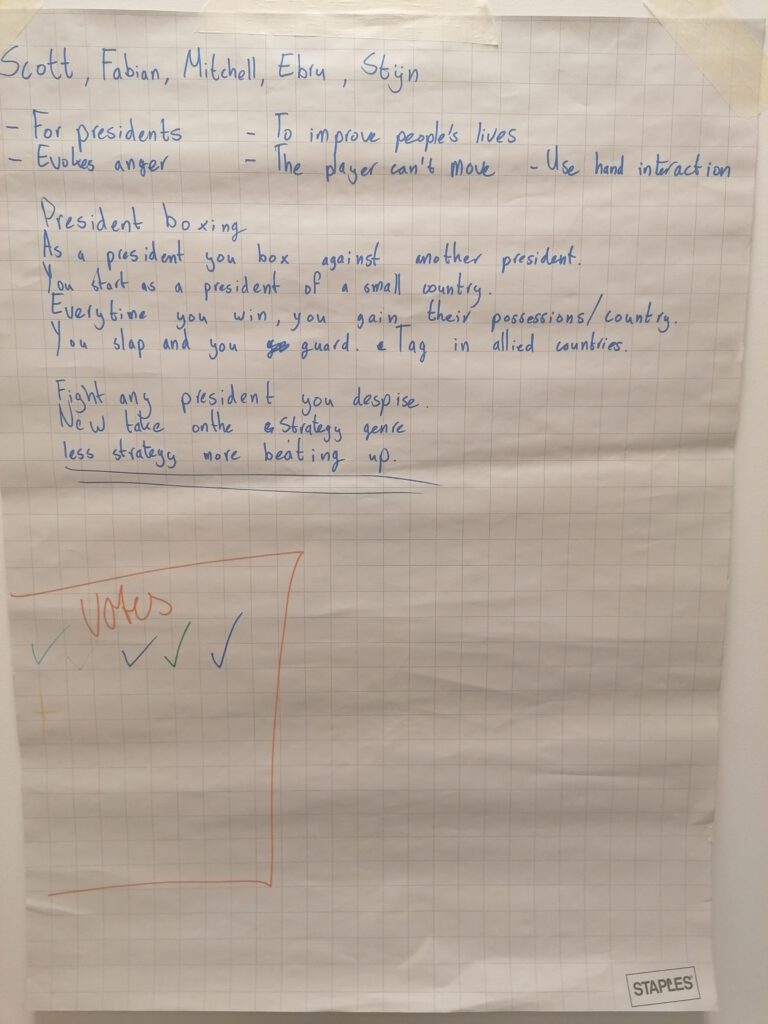
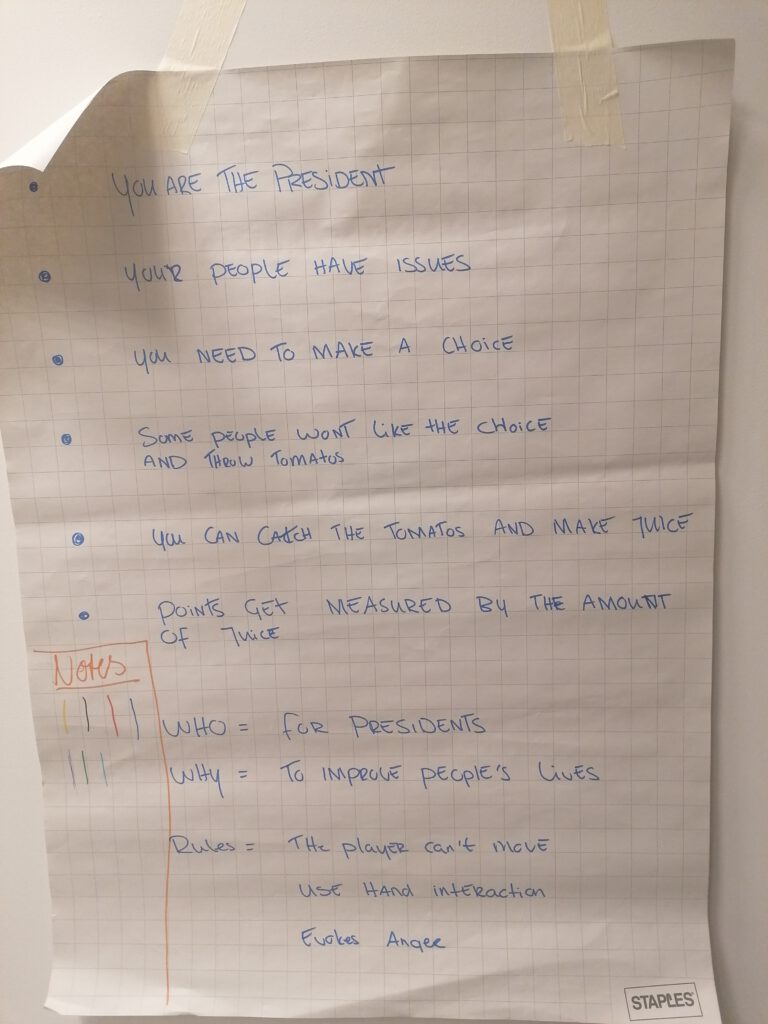
Brown boxing
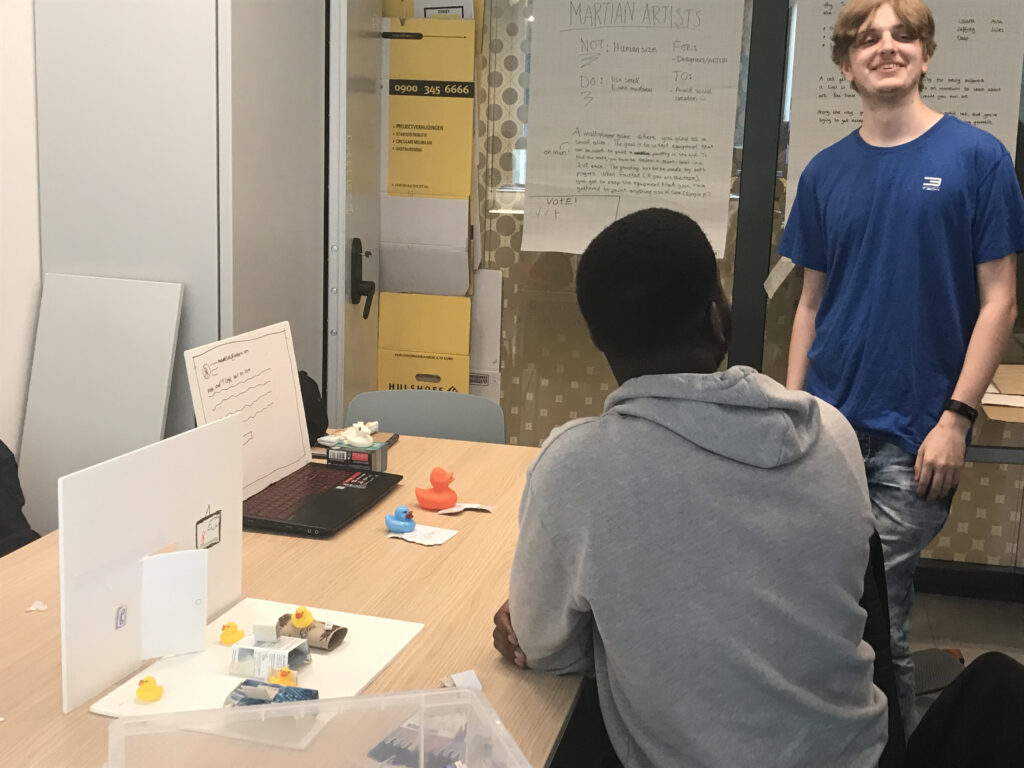
We had to make our concept of an anti-scamming expierence in real life using crafting supplies. This was to test the scale of the room and expierence of the user. I learned by using this technique you can simulate your VR experience in the real world.
White boxing/Styly
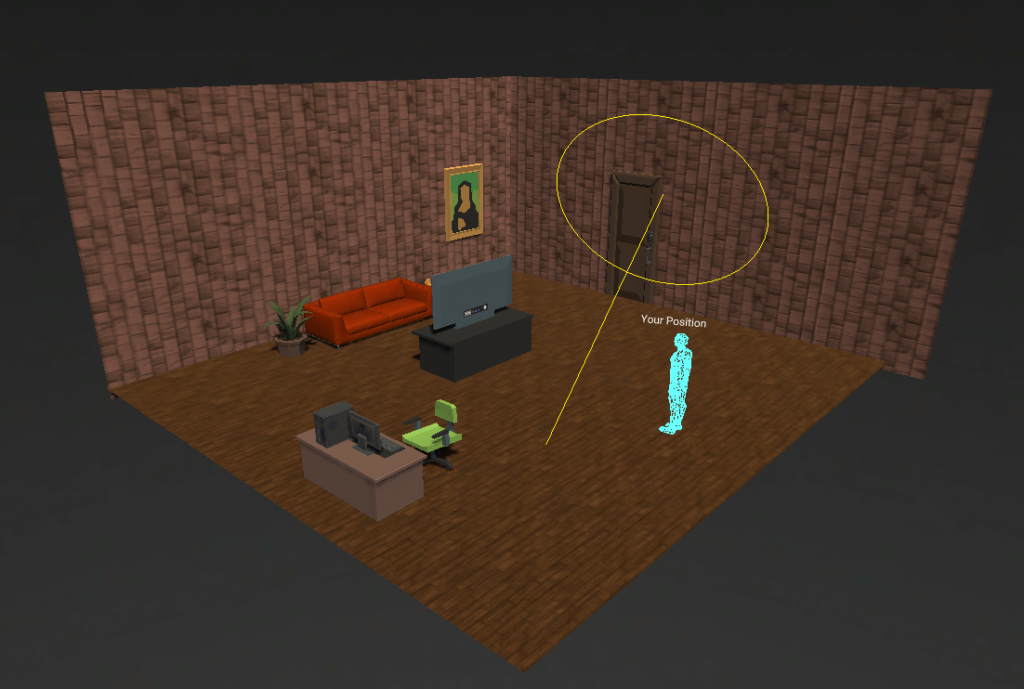
The goal here was to make a VR space of our concept.
We had to use styly to make our concept without any coding. A quick and easy way to make our concept in VR. I first thought about the style and I came up with low-poly. Then I thought about the most important parts about our concept: the different objects with interactions. So I made a livingroom with all of those objects in there.
Story elements
We learned about using stories in our VR experience. This can be used to involve people into your VR experience.
We had to make groups of 4 people each with different concepts and then discus amongst them which concept to choose and make a story around it. We choose the sea turtle concept and made a story as seen below.
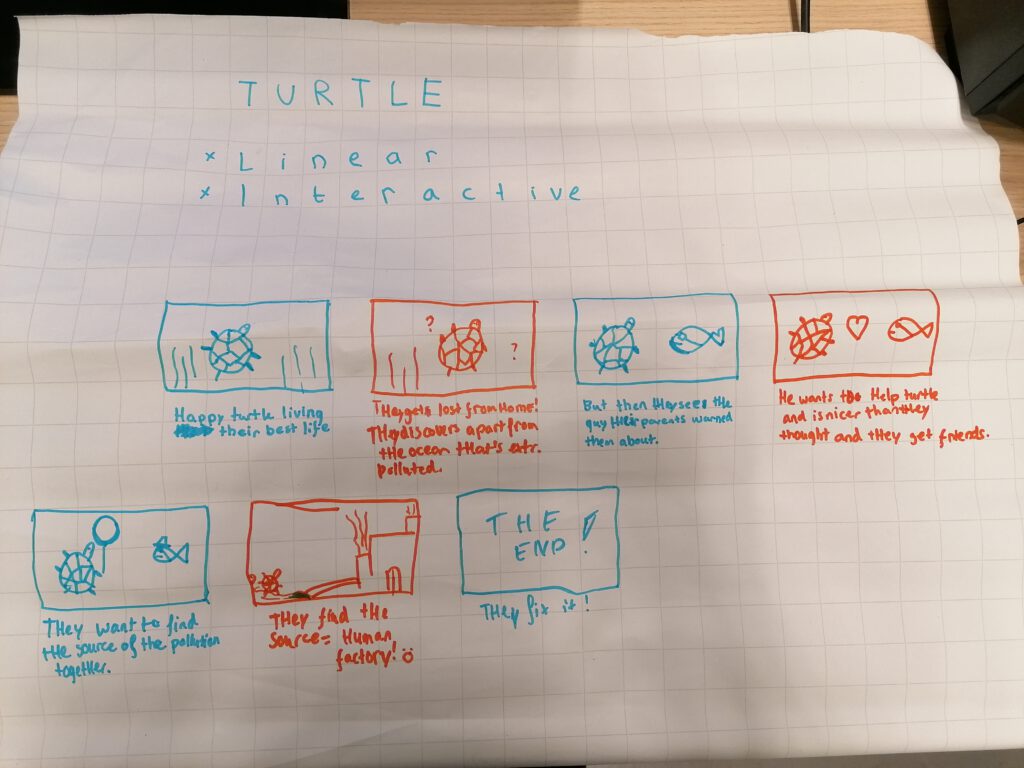
With this we learned that a story can be a good addition to an experience.
Pitches
We had to make five different pitches within a week. Each a different problem given to us by different companies. We sat around the table and said what came up in our heads. Inspark’s problem was “How can InSpark use the Holosuite in combination with the HoloLens 2 to position InSpark and optimally inspire the possibilities of Mixed Reality/Microsoft?”. For this we thought of a shooting game where the one that had control of the Holosuite could spawn enemies. The other players have different classes to have variety in how they play and each experience would be different. The enemies would first be seen on the holosuite screens for an impending effect and then flow over to the Hololens MR.
The next company was the fashion research and technology group. Their problem was “How do we build persistent and synchronous interactive world? How do we make them intuitive and enable citizens to influence the world and intertwine it with the physical world we are living in? And how does the metaverse affect our sense of belonging?”. This concept was getting material from a object and mold it to whatever you wanted to make and even change the material of it. With this you could have a freedom of identity and wouldn’t be constrained to the limits of the normal world.
Gemeente Amsterdam came to us with “How can you ensure that IV and CTO become more aware of our preconceptions and so become socially more diverse and inclusive?”. Here we had the concept of making a judge-system. You have someone before you and they have to be judged. You say if they are guilty and what their punishment is. This way we wanted to show a bias. After a talk with the teacher it changed to a murder mystery game where you get two people infront of you. Then two detectives talk to you about why they think a particular person is the guilty one and then you have to choose which one is guilty. After playing the game for a couple of rounds you would be confronted with your bias.
Shoeby’s challenge was “How can we use VR within the physical shop floor to create an enhanced shopping experience for the customer? Keeping in mind that the core value of Shoeby is personal and close by.”. We first came-up with that you can make your own catwalk show. You can dress different models, customize the environment and then other people can watch it and vote for the best one. With this we hoped we could inspire other customers of the possibilities with their clothing.
Then came Specialistennet with their challenge “How can VR/AR contribute to the prevention of psychological complaints?”. For this challenge we came up with a farm game to unstress people. After some feedback from the teacher we came up with your own personal naturepark. A space where you can relax in nature and you don’t have to do things. You can do things like painting or just meditating in the nature. Maybe catch some fish or other relaxing activity. We also thought about a buddy system where you can join someone in their world or someone joins you.
After the pitches we got Shoeby as our company.
Shoeby world
We changed our concept because of feedback from teachers. We would have a world with different biomes. Each biome had a different funtion, One would be where you make your avatar, the next would be where you could change clothes and the third would be a kind of photobooth. After some more feedback we came up with just one terrain where you can mold your avatar with hand tracking and grab clothes from the nature which is made of fashion and put them on your avatar.
Teleporting
Thinking about how to move in our VR experience we came up with teleportation. The first idea was to have teleportation by using your head to target and pinch to teleport where you were looking at. After some testing it became clear that it was too sensitive and it didn’t have a good feel to it. We first wanted teleportation because we had a big terrain. After that we were thinking about a hub and spoke system. I thought about spawning in a map with button where you can click on a part of the map and teleport to a hub. The first thing I thought about was if you rotate your hand so you have the palm of your hand to your face the map would appear. After trying to develop it, it became clear that it wasn’t possible with hand tracking. Then I thought about a button on your left arm, like a kind of smart device. It would be a button that if you click it, it would spawn a map.
Hand tracking or using controllers
After two sprints it became clear we should move to using controllers instead of hand tracking because of the following reasons:
- It was too limiting
- It doesn’t always work and recognises wrong movements
- Not enough documentation and therefore little help but also a lot of building yourself and some things do not work.
- It is more important to have full product than hand tracking and we can always add that later
Because of this, we will implement controllers instead of hand tracking in the third sprint.
How many scenes?
We wanted to go from one big scene where you can teleport to a hub and spoke system. With this in mind I thought about the performance. I wanted to research if it was beter to have one big scene with everything in it or multiple smaller scenes that would be loaded if you wanted to teleport. By searching on google I came across a few people asking the same question. The general concensus was
Big scene:
Pros:
Only load once.
References are easily maintained
Cons:
Long initial loading section.
Large runtime memory footprint.
Multiple scenes:
Pros:
Quicker loading sections.
Smaller runtime memory footprint.
Cons:
Loading screens will be seen when switching between areas.
References between Arenas will be more difficult to orchestrate.
I also asked a teacher for his opinion and he said the best thing to do is one big scene because of the scene loading. We could do both but if we chose to do the multiple little scenes we should make a fade-out and fade-in so the loading would be less obvious.